
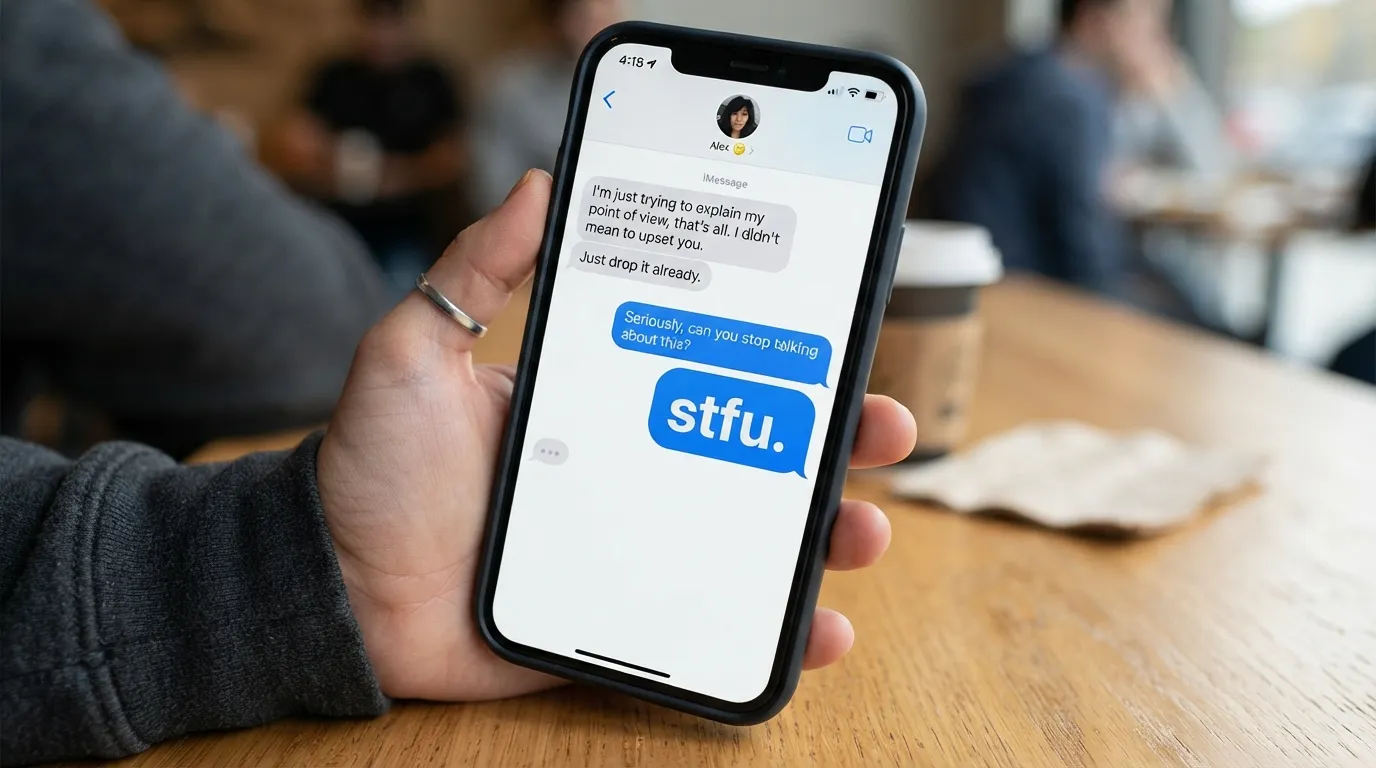
STFU in text stands for “shut the f* up.”** It’s a blunt phrase used to tell someone to stop talking, though its tone can shift a lot depending on how it’s used.
If you’ve seen STFU pop up in a text, comment, or group chat and paused to think it over, that reaction makes sense. It’s one of the more direct pieces of internet slang out there, and its meaning depends heavily on context.
You’ll spot STFU most often in texting, TikTok comments, Instagram DMs, and gaming or Discord chats. Sometimes it’s used aggressively, aimed at someone who said something rude. Other times, it’s used jokingly among friends, often as a reaction to something surprising or funny.
People search for this term because seeing profanity-based slang out of context can feel jarring, and knowing the tone helps avoid misreading a message. It’s one of those phrases where the words around it matter just as much as the letters themselves.
This guide explains exactly what STFU means, how tone changes it, and when it’s better left unsaid.
STFU Meaning in Text
In texting, STFU usually stands for “Shut the Fk Up.”**
Although the phrase sounds harsh, it doesn’t always mean someone is angry. Friends sometimes use STFU jokingly to react to exciting news, unbelievable stories, or funny situations.
For example:
- “You won the lottery? STFU!”
- “STFU, that’s the funniest thing I’ve heard today.”
- “No way! STFU!”
In these examples, STFU expresses shock or disbelief rather than telling someone to be quiet.
However, it can also be used literally during arguments.
For example:
- “STFU. I’m tired of arguing.”
In this case, the phrase is meant as an insult and may offend the other person.
Is STFU Slang or an Acronym?
STFU is both a texting acronym and a form of internet slang.
It represents a complete phrase and is widely used in informal online conversations. Because it contains profanity, it’s considered stronger than many other texting abbreviations.
What Does STFU Mean in Everyday Chat?
In everyday conversations, STFU can have different meanings depending on the tone.
It may express:
- Shock
- Surprise
- Excitement
- Disbelief
- Anger
- Frustration
Examples include:
- “STFU! You actually met your favorite actor?”
- “STFU, that’s amazing!”
- “STFU. Stop bothering me.”
Reading the rest of the conversation is the best way to understand whether it’s meant playfully or offensively.
Where People Use STFU
STFU appears on many social media platforms and messaging apps. Although the meaning stays the same, the tone often changes depending on who is using it and why.
STFU on TikTok
On TikTok, STFU is commonly used in comments and reaction videos.
People often write:
“STFU! This is incredible.”
Or:
“STFU, I can’t stop laughing.”
In these situations, the abbreviation usually expresses excitement or disbelief rather than hostility.
STFU on Snapchat
On Snapchat, STFU is mostly used in conversations between close friends.
Someone might send:
“STFU! You’re going on vacation?”
Or:
“STFU 😂 That’s hilarious.”
Friends often understand it’s meant as playful exaggeration rather than an insult.
STFU on Instagram
Instagram users frequently use STFU in comments, Reels, Stories, and captions.
Examples include:
“STFU! That outfit looks amazing.”
Or:
“STFU, this made my day.”
Because Instagram conversations are informal, the phrase is often used humorously among friends.
STFU on WhatsApp
On WhatsApp, STFU may appear in group chats or private conversations.
Examples include:
“STFU 😂 You’re joking.”
Or:
“STFU. I can’t believe that happened.”
The intended meaning depends entirely on the relationship between the people chatting.
STFU in SMS Text Messages
STFU also appears in regular text messages, especially between friends who are comfortable using informal language.
However, because it includes profanity, it’s generally avoided in conversations with teachers, coworkers, family members who may find it offensive, or anyone in a professional setting.
Why Is STFU So Popular?
STFU became popular because it expresses strong emotions using only four letters.
Whether someone is shocked, amused, or frustrated, the abbreviation quickly communicates an intense reaction without typing the full phrase.
Its popularity has grown through memes, gaming communities, viral videos, and social media trends. Still, because it contains explicit language, it’s important to think about your audience before using it. While close friends may understand it as a joke, others may find it rude or disrespectful.
Real Chat Examples
The easiest way to understand STFU is to see how people use it in real conversations. Below are 10 realistic texting examples that show both its playful and serious meanings.
Example 1
A: I just won VIP concert tickets!
B: STFU! That’s incredible!
A: I still can’t believe it.
Example 2
A: Guess who followed me back?
B: Who?
A: My favorite actor.
B: STFU! No way!
Example 3
A: I got a perfect score on the exam.
B: STFU! Congratulations!
A: Thanks!
Example 4
A: I accidentally sent the message to my boss.
B: STFU 😂
A: I’m so embarrassed.
Example 5
A: We booked tickets for Hawaii.
B: STFU! That’s going to be amazing.
A: I can’t wait.
Example 6
A: You forgot my birthday again.
B: I’m really sorry.
A: STFU. I’m upset right now.
Example 7
A: I met my favorite football player today.
B: STFU! Seriously?
A: I even got a picture.
Example 8
A: This pizza is terrible.
B: Then stop eating it. 😂
A: STFU.
Example 9
A: I finally bought my dream car.
B: STFU! That’s awesome.
A: It’s been my goal for years.
Example 10
A: I just got promoted.
B: STFU! You deserve it.
A: Thank you!
How to Reply When Someone Says “STFU”
Your response depends on whether the person is joking, expressing surprise, or speaking seriously.
Funny Replies
- “Make me. 😂”
- “You’re just jealous.”
- “I know, right?”
- “I couldn’t keep it a secret.”
Casual Replies
- “I know!”
- “It’s true.”
- “Believe it!”
- “I’m still shocked too.”
Friendly Replies
- “Haha, I had the same reaction.”
- “I knew you’d be surprised.”
- “Thanks! I’m excited too.”
- “I’m glad you liked the news.”
Neutral Replies
- “Really?”
- “What happened?”
- “Can you explain?”
- “Okay.”
If someone uses STFU in an angry or insulting way, it’s usually better to stay calm and avoid responding with more aggressive language.
Is STFU Rude or Offensive?
Yes, STFU can be rude because it contains profanity.
The phrase literally means “Shut the Fk Up,”** which many people consider offensive.
However, context matters.
Among close friends, STFU is often used as a playful reaction to exciting or unbelievable news. In these situations, it may not be intended as an insult.
On the other hand, using STFU during an argument or with someone you don’t know well can easily come across as disrespectful or aggressive.
It’s generally not appropriate for:
- School assignments
- Workplace communication
- Business emails
- Professional meetings
- Conversations with teachers or clients
When you’re unsure, it’s safer to choose a more polite expression.
Who Uses This Term?
STFU is most commonly used by:
- Teenagers
- Gen Z
- Millennials
- Gamers
- Active social media users
You’ll often see it on:
- TikTok
- Snapchat
- Discord
- X (formerly Twitter)
Although many adults recognize the abbreviation, younger users are generally more likely to use it in casual online conversations and memes.
Origin of the Term
STFU developed from the full phrase “Shut the Fk Up,”** which has been part of informal English for many years.
As texting and internet messaging became more popular, people shortened the phrase to four letters to type faster.
The abbreviation spread through online forums, gaming communities, memes, and later social media platforms like Twitter, TikTok, and Instagram.
Today, STFU is widely recognized around the world as a common internet slang acronym. Its meaning has expanded beyond insults and is now frequently used as a humorous expression of shock or disbelief among friends.
Comparison Table
| Acronym | Meaning | Type | Usage | Popularity |
| STFU | Shut the F**k Up | Slang Acronym | Surprise, disbelief, or telling someone to stop talking | Very High |
| IDK | I Don’t Know | Acronym | Expressing uncertainty | Very High |
| IDC | I Don’t Care | Acronym | Showing indifference | High |
| IMO | In My Opinion | Acronym | Sharing a personal opinion | High |
| BRB | Be Right Back | Acronym | Taking a short break from chatting | Very High |
Real-World Usage Example
Imagine your friend sends you a photo of a celebrity they unexpectedly met at a local café.
You reply:
“STFU! Are you serious?”
In this situation, you’re not telling your friend to be quiet. Instead, you’re expressing shock and excitement because the news is hard to believe.
Now imagine a different situation where two people are arguing in a group chat.
One person writes:
“STFU. I’m done with this conversation.”
Here, the phrase is being used literally and can come across as rude or offensive.
These examples show why context is so important. The same abbreviation can sound playful between close friends but disrespectful in an argument.
FAQs
What does STFU mean in text messages?
In text messages, STFU stands for “Shut the Fk Up.”** Depending on the context, it may express surprise, excitement, disbelief, or tell someone to stop talking.
What does STFU mean on TikTok?
On TikTok, STFU is often used in comments and reaction videos to show shock, excitement, or amusement. Many users write it jokingly rather than as an insult.
Is STFU slang?
Yes. STFU is an internet slang acronym commonly used in texting, memes, gaming, and social media conversations.
Is STFU rude or offensive?
It can be. Because STFU contains profanity, some people consider it offensive. Whether it sounds rude depends on the relationship between the people and the context in which it’s used.
How should you reply to STFU?
Your response depends on the situation. If it’s being used playfully, you might reply:
- “😂 I know!”
- “Believe it!”
- “Right?”
If it’s used angrily, it’s usually better to stay calm, avoid escalating the conversation, and respond respectfully or not respond at all.
Conclusion
STFU is a well-known internet slang acronym that stands for “Shut the Fk Up.”** While the phrase literally tells someone to stop talking, it’s often used jokingly among friends to express surprise, excitement, or disbelief.
You’ll commonly see STFU on TikTok, Snapchat, Instagram, WhatsApp, Discord, X (formerly Twitter), and in everyday text messages. Understanding the tone of the conversation is essential because the same abbreviation can be playful in one situation and offensive in another.
Although STFU is widely recognized online, it’s best to avoid using it in professional settings, school, or with people who may find profanity disrespectful. Knowing its meaning and context will help you interpret conversations more accurately and communicate appropriately.