
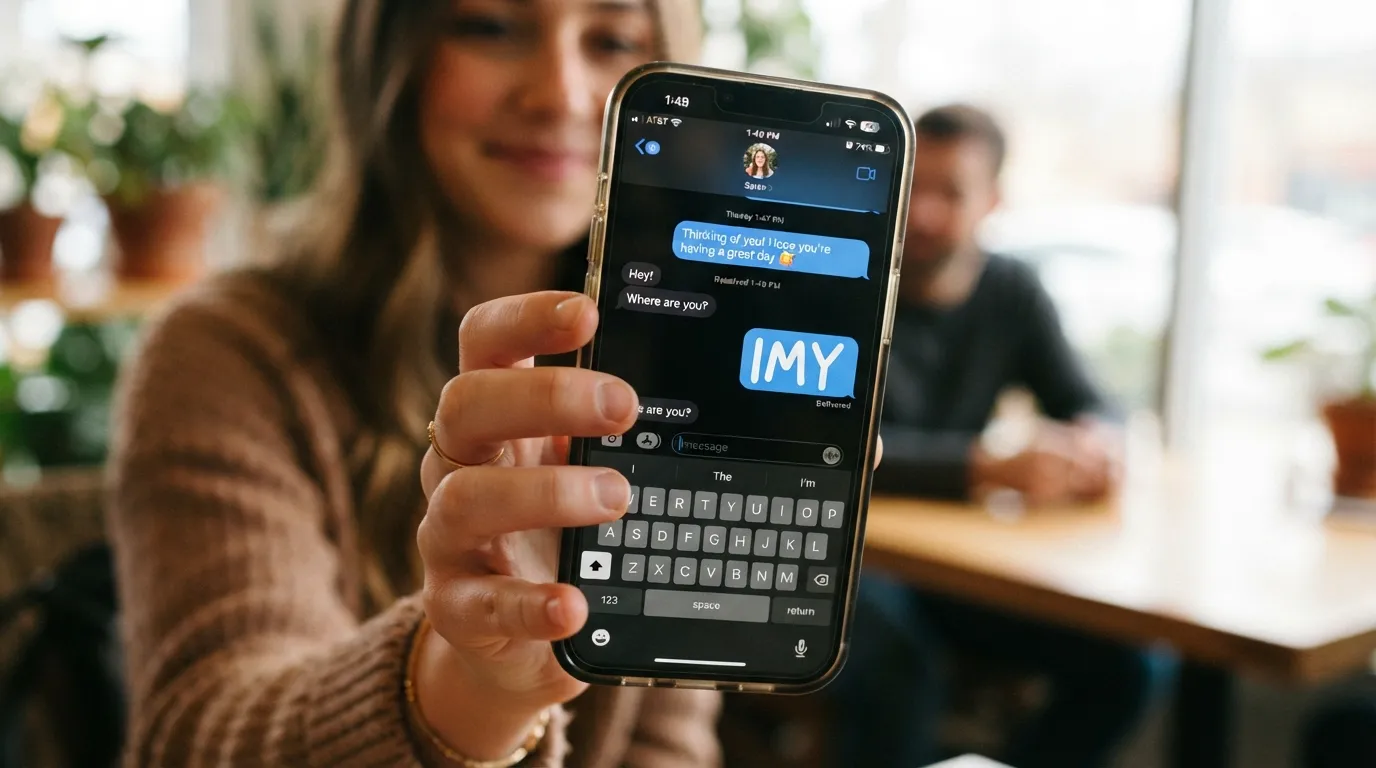
IMY in text means “I miss you.” It’s a short, casual way to let someone know you’re thinking about them, without typing out the full phrase.
If you’ve received a text or Snapchat that just said “IMY” and wondered what it meant, you’re not alone. Texting shorthand is everywhere now, and short emotional phrases like this one are easy to miss if you haven’t come across them before.
You’ll see IMY most often in texting, Snapchat, Instagram DMs, and WhatsApp chats. It usually shows up between friends, family, or partners after time apart, like “IMY, let’s catch up soon” or just “IMY” on its own.
People search for this term because it’s short enough to feel unclear at first, even though the meaning behind it is simple and sincere. It’s common in close relationships, but not limited to romantic ones.
This guide explains exactly what IMY means, where it shows up, and when it’s a good fit to use yourself.
IMY Meaning in Text
In texting, IMY stands for “I Miss You.”
It’s a simple and meaningful abbreviation that lets someone express their feelings without typing the full phrase. People use IMY when they’re away from someone they care about or simply want to let them know they’re being thought of.
For example:
- “IMY so much.”
- “It’s been too long. IMY.”
- “Can’t wait to see you. IMY!”
In each example, IMY expresses affection and emotional connection.
Is IMY Slang or an Acronym?
IMY is a texting acronym that represents the phrase “I Miss You.” While it’s often grouped with internet slang, it’s more accurately described as a messaging abbreviation used in casual online conversations.
Unlike humorous slang, IMY communicates genuine emotions and is commonly used in personal messages.
What Does IMY Mean in Everyday Chat?
In everyday conversations, IMY is used to let someone know they’re missed.
People may send it to:
- A close friend
- A family member
- A boyfriend or girlfriend
- A spouse
- Someone who lives far away
Examples include:
- “IMY already.”
- “Hope you’re doing well. IMY.”
- “School isn’t the same without you. IMY.”
- “Come home soon. IMY.”
Although the message is short, it often carries a lot of emotional meaning.
Where People Use IMY
IMY is widely used across social media platforms and messaging apps. While the meaning stays the same, people use it in different ways depending on the conversation.
IMY on TikTok
On TikTok, IMY often appears in captions, comments, and videos about friendships, relationships, or memories.
Examples include:
“IMY every day.”
Or:
“This song reminds me of you. IMY.”
Creators also use IMY in emotional videos dedicated to loved ones or people they haven’t seen in a long time.
IMY on Snapchat
On Snapchat, IMY is commonly sent in private chats between friends and romantic partners.
Someone might message:
“IMY. When are we hanging out again?”
Or:
“IMY already. It’s only been one day.”
Because Snapchat focuses on personal communication, IMY is one of the most frequently used emotional abbreviations.
IMY on Instagram
Instagram users often include IMY in Stories, captions, comments, and direct messages.
For example:
“IMY ❤️”
Or:
“Wish you were here. IMY.”
It’s commonly used when sharing old photos, vacation memories, or posts dedicated to someone special.
IMY on WhatsApp
On WhatsApp, IMY is popular in conversations with friends, family members, and loved ones.
Examples include:
“IMY. Call me when you’re free.”
Or:
“We’ve been apart for too long. IMY.”
Using IMY makes it quick and easy to express emotions without typing a longer message.
IMY in SMS Text Messages
IMY has been one of the most popular texting abbreviations for years.
People often send it in regular text messages to remind someone they’re loved and missed.
Although modern phones make typing easier, IMK remains popular because it’s short, meaningful, and instantly recognizable.
Why Is IMY So Popular?
IMY has remained popular because it’s simple, sincere, and easy to understand.
Instead of typing “I miss you” every time, people can express the same feeling using just three letters.
Whether it’s sent after a long day, during a trip, or after moving to a new city, IMY helps people stay emotionally connected through text. While it’s perfect for personal conversations, it’s generally not appropriate for professional emails or formal communication.
Real Chat Examples
The easiest way to understand IMY is to see how people naturally use it in everyday conversations. Here are 10 realistic texting examples.
Example 1
A: It’s been a week since we last met.
B: I know. IMY.
A: I miss you too.
Example 2
A: How’s college going?
B: It’s great, but IMY.
A: We’ll see each other soon.
Example 3
A: I just looked at our old photos.
B: Same here. IMY so much.
A: Those were great memories.
Example 4
A: When are you coming home?
B: Next weekend.
A: IMY already.
Example 5
A: Happy Birthday!
B: Thank you!
A: IMY. Hope we can celebrate together next time.
Example 6
A: The office feels so quiet today.
B: Really?
A: Yeah, IMY.
Example 7
A: I saw your favorite restaurant today.
B: That made me smile.
A: IMY.
Example 8
A: I wish you were here for the concert.
B: Me too.
A: IMY.
Example 9
A: Mom keeps asking about you.
B: Tell her I’ll visit soon.
A: She IMY too.
Example 10
A: Have a safe flight.
B: Thanks!
A: IMY already. Take care.
How to Reply When Someone Says “IMY”
When someone sends IMY, they’re expressing affection or letting you know they miss you. Your response can be warm, friendly, or playful depending on your relationship.
Funny Replies
- “You just saw me yesterday. 😂”
- “Miss me already?”
- “I knew you’d miss me!”
- “Don’t worry, I’ll be back soon.”
Casual Replies
- “IMY too.”
- “Same here.”
- “Can’t wait to see you.”
- “I was thinking about you too.”
Friendly Replies
- “That means a lot. Thank you.”
- “I miss you too. Let’s catch up soon.”
- “Hope we can meet soon.”
- “Take care. See you soon.”
Neutral Replies
- “Thanks!”
- “Hope you’re doing well too.”
- “Looking forward to seeing you.”
- “Appreciate your message.”
A sincere reply usually makes the conversation feel more personal and meaningful.
Is IMY Rude or Offensive?
No. IMY is not rude or offensive.
In fact, it’s considered one of the kindest and most positive texting abbreviations because it expresses care and affection.
People commonly use IMY with:
- Friends
- Family members
- Romantic partners
- Classmates
- Close coworkers
However, because IMY is personal, you should use it only with people you’re comfortable expressing emotions to.
It’s generally not appropriate in:
- Business emails
- Professional documents
- Formal workplace communication
- Official messages
In those situations, writing complete and professional sentences is usually a better choice.
Who Uses This Term?
IMY is widely used by people of all ages, although it’s especially common among:
- Teenagers
- Gen Z
- Millennials
- Couples
- Close friends
- Family members
You’ll frequently see IMY on:
- TikTok
- Snapchat
- Facebook Messenger
- SMS text messages
Unlike some internet slang that comes and goes, IMY has remained popular for many years because its meaning is simple, heartfelt, and universally understood.
Origin of the Term
IMY became popular during the early years of online messaging and SMS texting, when people looked for faster ways to communicate.
As texting grew, common phrases were shortened into easy-to-type abbreviations. “I Miss You” naturally became IMY, allowing people to express emotions quickly without typing the full sentence.
Over time, IMY spread across instant messaging apps, social media platforms, and smartphones. Today, it’s one of the most widely recognized texting abbreviations used around the world.
Comparison Table
| Acronym | Meaning | Type | Usage | Popularity |
| IMY | I Miss You | Texting Acronym | Expressing affection or missing someone | Very High |
| IDK | I Don’t Know | Acronym | Expressing uncertainty | Very High |
| IDC | I Don’t Care | Acronym | Showing indifference | High |
| IMO | In My Opinion | Acronym | Sharing an opinion | High |
| BRB | Be Right Back | Acronym | Letting someone know you’ll return soon | Very High |
Real-World Usage Example
Imagine your best friend has moved to another city for college. You haven’t seen each other in several months, but you still chat regularly.
One evening, your friend texts:
“IMY. College is fun, but it isn’t the same without you.”
You reply:
“IMY too! We should plan a trip soon.”
In another situation, a family member is traveling for work. Before ending the conversation, you send:
“Take care. IMY already!”
These examples show how IMY helps people express affection and stay emotionally connected, even when they’re far apart.
FAQs
What does IMY mean in text messages?
In text messages, IMY stands for “I Miss You.” People use it to tell someone they’re thinking about them and wish they were together.
What does IMY mean on TikTok?
On TikTok, IMY is often used in captions, comments, and videos to express missing a friend, family member, partner, or a special memory.
Is IMY slang?
IMY is a texting acronym rather than traditional slang. It’s a common internet abbreviation used in casual online conversations.
Is IMY rude or offensive?
No. IMY is a positive and respectful expression. It’s commonly used to show affection, appreciation, or emotional connection.
How should you reply to IMY?
A few natural replies include:
- “IMY too!”
- “I can’t wait to see you.”
- “Same here.”
- “Miss you too. Take care!”
- “Let’s meet soon.”
Conclusion
IMY is one of the most popular and heartfelt texting abbreviations, standing for “I Miss You.” It’s a simple way to let someone know they’re important to you and that you’re thinking about them.
You’ll commonly see IMY on TikTok, Snapchat, Instagram, WhatsApp, Facebook Messenger, and in everyday text messages. Whether it’s shared between friends, family members, or romantic partners, the message usually expresses warmth, care, and emotional connection.
Although IMY is perfect for personal conversations, it’s best to avoid using abbreviations in formal emails or professional communication. Understanding what IMY means will help you communicate more naturally and confidently in today’s digital world.