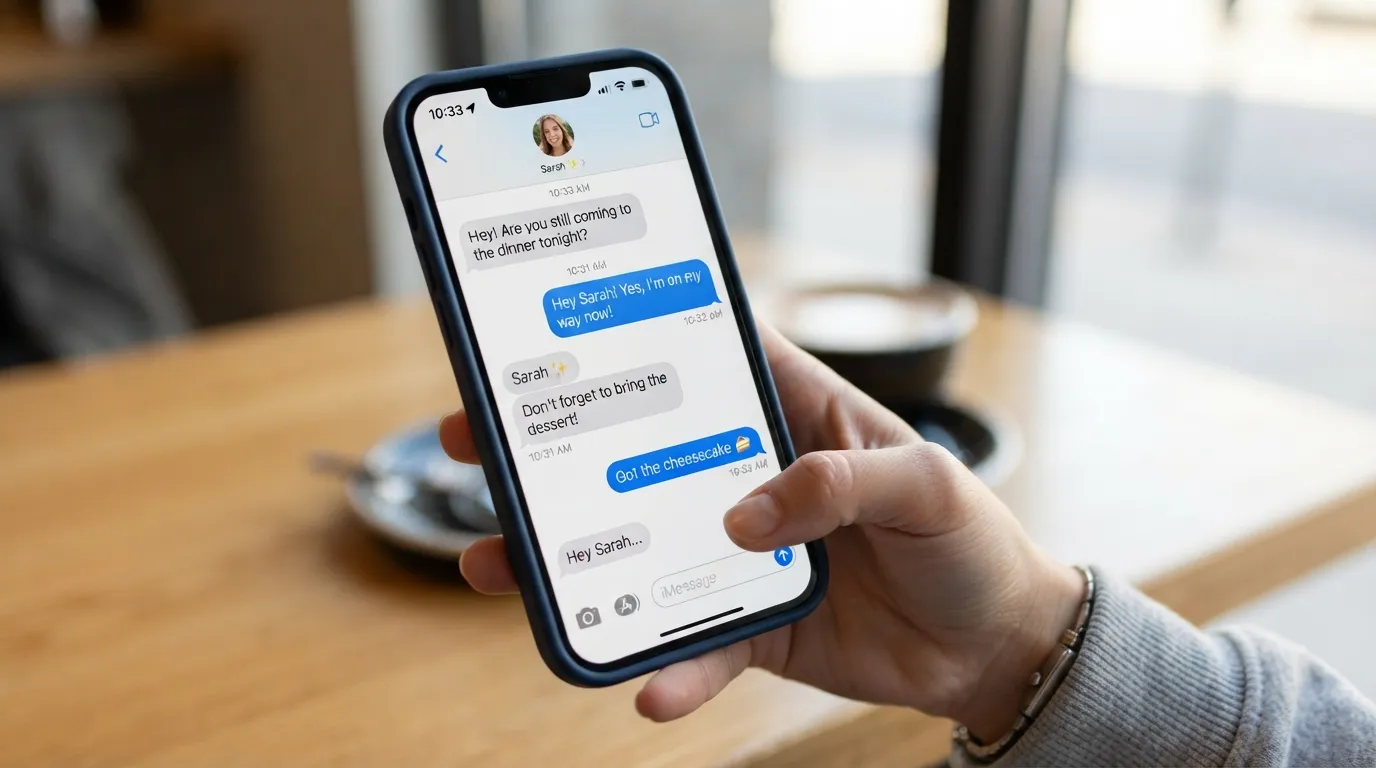
SMS in text messages stands for “Short Message Service,” the basic technology phones use to send plain text messages over a cellular network, without needing Wi-Fi or a data plan.
If you’ve ever sent a text and suddenly noticed it labeled “sent as SMS” instead of the usual blue or green bubble you expect, that switch can feel confusing, even a little alarming. The good news is, it almost never means anything is wrong on your end.
You’ll typically see SMS come up in iPhone Messages, Android texting apps, and group chats, especially when a message switches from iMessage or RCS to SMS. This usually happens when the recipient loses internet connection, has an older phone, or isn’t using the same messaging service as you.
People search for this term because seeing “SMS” appear unexpectedly can raise questions, like whether they’ve been blocked or something’s broken. In reality, it’s just phones falling back on the most universal texting method available.
This guide explains exactly what SMS means, why it appears, and what it does and doesn’t tell you.
SMS Meaning in Text Messages
SMS stands for Short Message Service.
It is the standard mobile messaging service that lets users send and receive text-only messages between mobile phones. Unlike apps such as WhatsApp or Telegram, SMS usually works through your mobile carrier’s network instead of an internet connection.
For example:
- “I’ll send you the code by SMS.”
- “I received an SMS from my bank.”
- “The verification code was sent via SMS.”
In each example, SMS simply refers to a standard text message.
Is SMS Slang or an Acronym?
SMS is not internet slang.
It is a technical acronym that stands for Short Message Service, a communication standard developed for mobile phones.
Unlike abbreviations such as LOL, BRB, or IDK, SMS is an official telecommunications term that’s recognized worldwide.
What Does SMS Mean in Everyday Use?
In everyday conversations, people use SMS when referring to regular text messages sent through a mobile network.
Common examples include:
- Sending a friend a text message
- Receiving a one-time password (OTP)
- Getting a bank notification
- Receiving delivery updates
- Confirming appointments
- Receiving security verification codes
Examples include:
- “Please send the verification code by SMS.”
- “I got an SMS confirming my order.”
- “You’ll receive an SMS when your package arrives.”
- “The doctor sent an appointment reminder by SMS.”
Unlike internet messaging apps, SMS can often be sent even when the recipient doesn’t have a smartphone or a data connection.
Where People Use SMS
SMS is used across many industries and services because it’s reliable and works on almost every mobile phone.
SMS for Personal Text Messages
Many people still use SMS to communicate with friends and family, especially when mobile data or Wi-Fi isn’t available.
Examples include:
“I’ll text you by SMS when I arrive.”
Or:
“Did you get my SMS?”
It’s one of the simplest ways to stay in touch.
SMS for Verification Codes
Many websites and apps send one-time passwords (OTPs) through SMS to verify your identity.
Examples include:
“Your verification code has been sent via SMS.”
Or:
“Enter the SMS code to continue.”
This is one of the most common uses of SMS today.
SMS for Banking Alerts
Banks frequently use SMS to notify customers about account activity.
Examples include:
“Your payment was successful.”
Or:
“A withdrawal of $200 was made from your account.”
These alerts help customers monitor their accounts in real time.
SMS for Delivery Updates
Courier companies often send SMS notifications about package deliveries.
Examples include:
“Your package is out for delivery.”
Or:
“Your order has been delivered.”
Customers receive important updates without needing a messaging app.
SMS for Appointment Reminders
Healthcare providers, salons, schools, and other organizations commonly send reminders by SMS.
Examples include:
“Your appointment is tomorrow at 2:00 PM.”
Or:
“Reply YES to confirm your appointment.”
These reminders help reduce missed appointments.
Why Is SMS Still Important?
Even with the rise of internet messaging apps, SMS remains an essential communication method because it works on nearly every mobile phone and doesn’t require users to install a specific application.
Businesses, banks, healthcare providers, government agencies, and online services continue to rely on SMS for important notifications, verification codes, security alerts, and customer communication.
Because SMS is supported by virtually every mobile carrier worldwide, it remains one of the most trusted and widely used forms of mobile messaging.
Real Chat Examples
The easiest way to understand SMS is to see how it’s used in everyday conversations. Here are 10 realistic examples where SMS means “Short Message Service” or a standard text message.
Example 1
A: I just sent you the verification code.
B: By WhatsApp?
A: No, check your SMS.
Example 2
A: Did you receive the appointment reminder?
B: Yes, it came by SMS this morning.
A: Great!
Example 3
A: I can’t access my account.
B: Request a new SMS verification code.
A: I’ll try that.
Example 4
A: Your package has shipped.
B: How will I know when it arrives?
A: You’ll receive an SMS update.
Example 5
A: I got a message from my bank.
B: Was it an SMS alert?
A: Yes, it confirmed my payment.
Example 6
A: My internet isn’t working.
B: That’s okay. Just send me an SMS.
A: Will do.
Example 7
A: The website says it sent a code.
B: Check your SMS inbox.
A: I found it.
Example 8
A: Can I message you without Wi-Fi?
B: Yes, just send an SMS.
A: Perfect.
Example 9
A: The clinic reminded me about tomorrow’s appointment.
B: By email?
A: No, by SMS.
Example 10
A: I changed my phone number.
B: Okay, send me an SMS so I can save it.
A: Done!
How to Reply When Someone Says “SMS”
If someone mentions SMS, they’re usually referring to a standard text message. Here are some natural replies.
Casual Replies
- “I’ll check my SMS.”
- “Thanks, I got it.”
- “I’ll send you an SMS.”
- “Okay, I’ll text you.”
Friendly Replies
- “Thanks for letting me know!”
- “I received your SMS.”
- “I’ll reply as soon as I see it.”
- “I’ll send you the details by SMS.”
Neutral Replies
- “Understood.”
- “Message received.”
- “Okay.”
- “I’ll check my inbox.”
If You Didn’t Receive the SMS
You can reply with:
- “I haven’t received it yet.”
- “Can you send it again?”
- “I’ll check my messages.”
- “The SMS hasn’t arrived.”
These responses are common when waiting for verification codes or important notifications.
Is SMS Rude or Offensive?
No. SMS is not rude or offensive.
SMS is a technical term used worldwide to describe standard text messaging.
People use SMS for:
- Personal conversations
- Verification codes (OTP)
- Banking alerts
- Appointment reminders
- Delivery notifications
- Business communication
- Customer support
Because SMS is a formal telecommunications term, it’s appropriate in both casual and professional settings.
Who Uses SMS?
SMS is used by nearly everyone with a mobile phone, including:
- Students
- Parents
- Professionals
- Businesses
- Banks
- Healthcare providers
- Government agencies
- Online services
You’ll commonly encounter SMS for:
- Two-factor authentication (2FA)
- One-time passwords (OTP)
- Order confirmations
- Flight updates
- Security alerts
- Everyday text conversations
Unlike many messaging apps, SMS works on almost every mobile phone without requiring an internet connection.
Origin of the Term
SMS stands for Short Message Service, a mobile messaging standard developed in the early days of digital cellular networks.
It was introduced as part of the GSM (Global System for Mobile Communications) standard and quickly became one of the most popular ways to exchange short text messages.
As smartphones evolved, internet-based messaging apps became more common. However, SMS remains an essential communication method because of its reliability, broad compatibility, and widespread support by mobile carriers around the world.
Comparison Table
| Term | Meaning | Type | Usage | Popularity |
| SMS | Short Message Service | Technical Acronym | Sending standard text messages over a mobile network | Very High |
| MMS | Multimedia Messaging Service | Technical Acronym | Sending photos, videos, and audio via mobile networks | High |
| RCS | Rich Communication Services | Messaging Standard | Enhanced messaging with read receipts and media sharing | Growing |
| Internet Messaging App | Messaging Platform | Texting, calling, and media sharing over the internet | Very High | |
| Electronic Mail | Communication Service | Formal and personal digital communication | Very High |
Real-World Usage Example
Imagine you’re signing in to your online banking account.
After entering your username and password, you see this message:
“A verification code has been sent to your phone via SMS.”
A few seconds later, your phone receives a text message:
Bank: “Your verification code is 482931. Do not share this code with anyone.”
You enter the code, and your account is verified successfully.
In another situation, you’ve ordered a package online.
A delivery company sends you this SMS:
“Your package is out for delivery and will arrive today between 2:00 PM and 5:00 PM.”
These examples show that SMS is commonly used to send important text-only messages, including verification codes, delivery updates, appointment reminders, and personal text messages.
FAQs
What does SMS mean in text messages?
SMS stands for Short Message Service. It is the standard technology used to send and receive text-only messages between mobile phones over a cellular network.
What is the difference between SMS and a text message?
An SMS is a type of text message. In everyday conversation, people often use the terms interchangeably. However, SMS specifically refers to text-only messages sent through a mobile carrier’s network.
Does SMS require the internet?
No. SMS does not require an internet connection. It works through your mobile carrier’s cellular network, which is why you can usually send and receive SMS messages even without Wi-Fi or mobile data.
Is SMS free?
It depends on your mobile phone plan. Some carriers include unlimited SMS messaging, while others may charge per message or offer a limited number of free texts.
Why do companies send SMS messages?
Businesses use SMS because it’s fast, reliable, and works on almost every mobile phone. Common uses include:
- Verification codes (OTP)
- Banking alerts
- Delivery notifications
- Appointment reminders
- Security alerts
- Promotional offers
Conclusion
SMS stands for Short Message Service, the standard technology used to send text-only messages between mobile phones. Even though messaging apps like WhatsApp and Telegram are widely used today, SMS remains an essential communication method for personal texting, security verification, banking notifications, appointment reminders, and business updates.
Because SMS works through a mobile carrier’s network instead of the internet, it’s compatible with nearly every mobile phone and continues to be one of the most reliable ways to deliver important information.
Understanding what SMS means helps you recognize why so many businesses, organizations, and mobile users continue to rely on it every day.